The Venetian Trade Network: Spices, Shipping, and Information Across the Mediterranean
Venetian prosperity depended on sea routes, convoys, merchants, brokers, warehouses, privileges, and market information.
Why this story matters
The Venetian Trade Network matters because it reveals how power, wealth, or strategic capacity was built through institutions rather than slogans. The article separates the famous surface story from the operating mechanisms underneath it.
Historical setting
Mediterranean trade linked Alexandria, Constantinople, the Adriatic, Italy, and northern Europe.
Chronology
1200s–1300s
Venetian merchant colonies and privileges expanded.
1400s
State-organized shipping systems connected major routes.
1500s
Portuguese routes around Africa altered but did not instantly eliminate Venetian spice commerce.
How the system actually worked
1. Convoys reduced some risk
State-regulated fleets concentrated protection and schedules.
2. Merchant colonies reduced information friction
Resident communities understood local markets and law.
3. Credit linked shipments over time
Trade depended on finance as much as ships.
Institutions, people, and incentives
The Venetian Trade Network depended on more than individual talent. The outcome involved organizations, counterparties, political rules, capital, specialized labor, and networks whose incentives did not always align.
The central analytical point is that historical power did not sit only inside one famous person. It traveled through institutions, contracts, families, military units, religious bodies, commercial partners, creditors, officials, artisans, local elites, and information networks. A biography becomes more accurate when those surrounding systems remain visible.
What the simplified story gets wrong
The Cape route did not cause Venice to collapse overnight.
Popular history often compresses a long institutional process into one personality trait: genius, ruthlessness, courage, greed, vision, or luck. Those traits can matter, but they rarely explain why resources moved, why allies stayed loyal, why orders were obeyed, or why a system survived after the dramatic event ended.
Money, logistics, and information
The material side of The Venetian Trade Network depended on some combination of credit, taxation, trade, wages, supply, transport, accounting, land, commodities, or public finance. Those constraints shaped which choices were feasible and which were only rhetoric.
In premodern and early industrial systems, information could take days or months to travel. Cash and specie could be in the wrong city. Grain could exist but not reach the army. Credit could be available but not trusted. A reliable network often created advantage by solving those apparently boring coordination problems.
Risk and failure
The same system that created advantage in The Venetian Trade Network also created fragility. Concentration, succession, overextension, weak oversight, changing technology, and political shocks could turn strength into exposure.
Success can hide weakness for years. Expansion stretches oversight, prestigious customers can become dangerous debtors, political access can become dependence, founders can fail to transfer judgment, and organizations optimized for one geography or technology can become fragile when the environment changes.
What historians can and cannot know
The evidence for The Venetian Trade Network is uneven. This article uses conservative claims and treats disputed motives, legendary anecdotes, and uncertain numbers as interpretation rather than fact.
Letters survive selectively, account books are incomplete, rulers present themselves strategically, chroniclers write with political and moral agendas, and later generations often add legends. The responsible response to a gap is not to invent a cinematic answer; it is to preserve the uncertainty.
Legacy
Venice demonstrates how logistics, institutions, and market information compound.
What can cautiously be learned today
The modern value of The Venetian Trade Network is structural: study resource flow, incentives, information, governance, logistics, and succession. Historical effectiveness is not treated as moral endorsement and political or military tactics are not copied literally into business.
- Where did real power sit?
- Which institution made scale possible?
- What information advantage mattered?
- What resource became the binding constraint?
- Which failure mode was hidden during success?
- What survived the founder, ruler, or commander?
Frequently asked questions
Why is The Venetian Trade Network important?
Because it reveals how historical outcomes emerged from systems of power, finance, logistics, and institutions rather than from one dramatic event alone.
Are the famous anecdotes all reliable?
No. The article distinguishes well-supported facts from later legend and contested interpretation.
Does this article invent dialogue or motives?
No. Unsupported dialogue and exact motives are excluded.
Can the history be applied directly to business?
Only cautiously. Mechanisms may transfer; political, military, colonial, or coercive behavior does not.
What sources are used?
Established historical scholarship and, where practical, primary or archival material relevant to the topic.
The decision environment
The Venetian Trade Network: Spices, Shipping, and Information Across the Mediterranean is easier to understand when the decision environment is reconstructed before the result is known. Historical actors did not possess the clean chronology available to later readers. They worked with delayed reports, incomplete accounts, personal loyalties, institutional rules, uncertain opponents, and material constraints. A strong interpretation therefore asks what information was plausibly available at each major decision point instead of treating the eventual outcome as obvious.
For Venetian trade network, this matters because hindsight can turn contingency into destiny. The useful question is not “Why did they fail to foresee what we now know?” but “Which options were credible given the institutions, resources, beliefs, and information of the period?” This produces a fairer historical analysis and a better model for modern decision reviews.
The network behind the visible leader
Even when The Venetian Trade Network: Spices, Shipping, and Information Across the Mediterranean centers on a famous family, ruler, banker, or commander, the visible figure sat on top of a network. That network could include relatives, partners, scribes, accountants, soldiers, merchants, tax collectors, local elites, religious institutions, artisans, diplomats, shipowners, creditors, and clients. Removing those people creates a biography that is dramatic but mechanically empty.
A practical way to read the network is to ask four questions: who supplied resources, who supplied information, who converted orders into action, and who had enough leverage to refuse. Those four groups often explain both the speed of expansion and the point at which expansion stopped.
Second-order consequences
The first visible outcome in Venetian trade network was rarely the final consequence. A successful campaign created occupation costs. A banking relationship created credit exposure. A palace or public work created maintenance obligations. A new office changed future competition for status. A commercial monopoly encouraged political opposition. The second-order effects frequently determined whether the original success compounded or decayed.
This is one reason the articles in this series do not end at the famous victory, accession, financing deal, or construction project. The more revealing question is what the achievement forced the system to do next—and whether the institution possessed the money, legitimacy, labor, and administrative capacity to do it.
Comparing reputation with operating reality
Historical reputations are compressed brands. The Venetian Trade Network: Spices, Shipping, and Information Across the Mediterranean may be remembered through magnificence, genius, ruthlessness, wealth, reform, military brilliance, or innovation. Those labels can be useful shorthand, but they should be tested against operating evidence: accounts, correspondence, laws, contracts, campaigns, institutional changes, and the behavior of counterparties.
The gap between reputation and operation is often where the most valuable history appears. A ruler praised for centralization may still depend on local intermediaries. A financier famous for wealth may operate with fragile liquidity. A commander celebrated for speed may depend on slow logistical preparation. Reputation describes how history remembers the actor; operating reality explains how the system worked.
A research checklist for deeper study
Readers who want to go beyond this overview of Venetian trade network should separate sources into layers. Start with contemporary or near-contemporary evidence when available: letters, ledgers, legal texts, inscriptions, official records, memoirs, or chronicles. Then use modern scholarly work to reconstruct institutions and challenge the biases of the surviving record.
For every strong claim, ask what type of evidence supports it. For every dramatic anecdote, ask when it first appears in the record. For every exact number, ask whether it is contemporary, reconstructed, or rhetorical. This source discipline is especially important in the history of wealth and power, where later admirers and enemies both have incentives to exaggerate.
Why this belongs in Millionaire Lesson
The purpose of studying The Venetian Trade Network: Spices, Shipping, and Information Across the Mediterranean here is not to turn historical figures into motivational mascots. History adds value because it forces modern ideas about strategy, leadership, money, and power to confront real constraints. Institutions fail, credit dries up, alliances shift, heirs disappoint, technology changes, and victories create new obligations.
That makes the past a useful laboratory for mechanisms. The goal is to understand how systems accumulated capability, what made them fragile, and how consequences unfolded across time. The lesson is strongest when the history remains intact rather than being rewritten to prove a predetermined business slogan.
Final idea
The Venetian Trade Network becomes more useful when the mythology is stripped away. The durable lesson is not to imitate a historical figure, but to understand the system that made particular choices possible, the costs those choices imposed, and why that system eventually changed.
Continue Reading
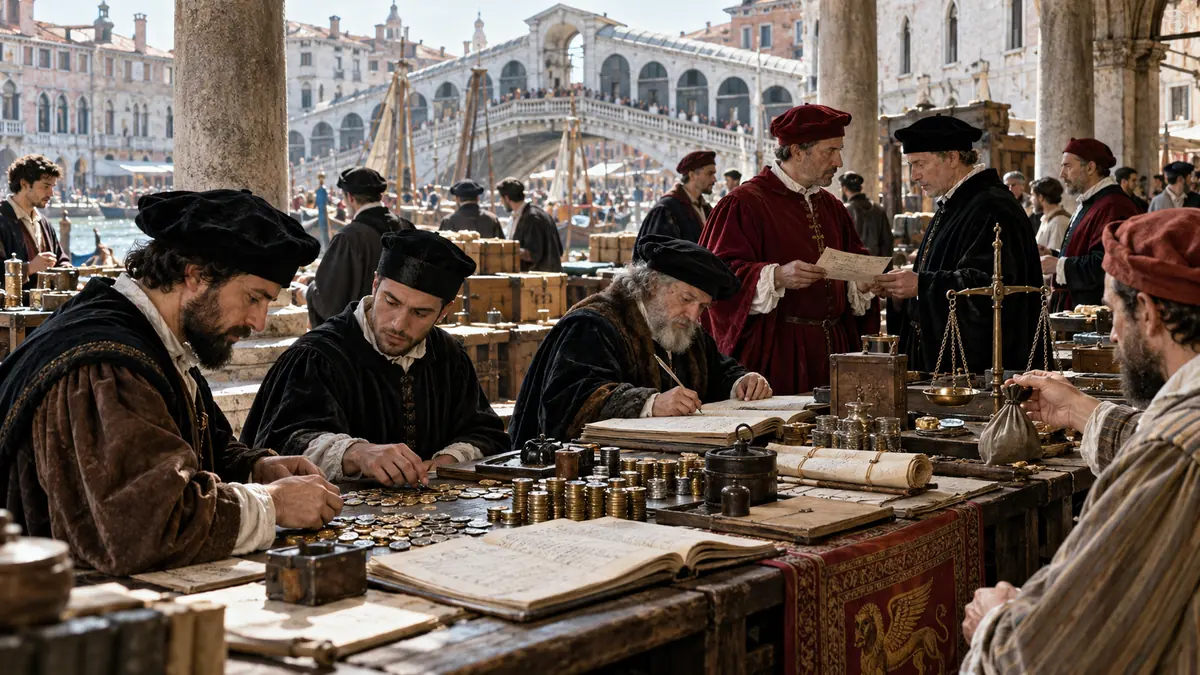
Venetian Banking and Credit: How Commerce Worked Before Modern Banks
Venetian commerce required deposits, payments, exchange, credit, public debt, partnerships, and institutions that reduced settlement risk.
Read article →
The Bank of Saint George: Genoa’s Experiment in Public Debt and Financial Power
Founded in 1407, the Bank of Saint George emerged from Genoa’s public-debt system and became one of Europe’s most remarkable early financial…
Read article →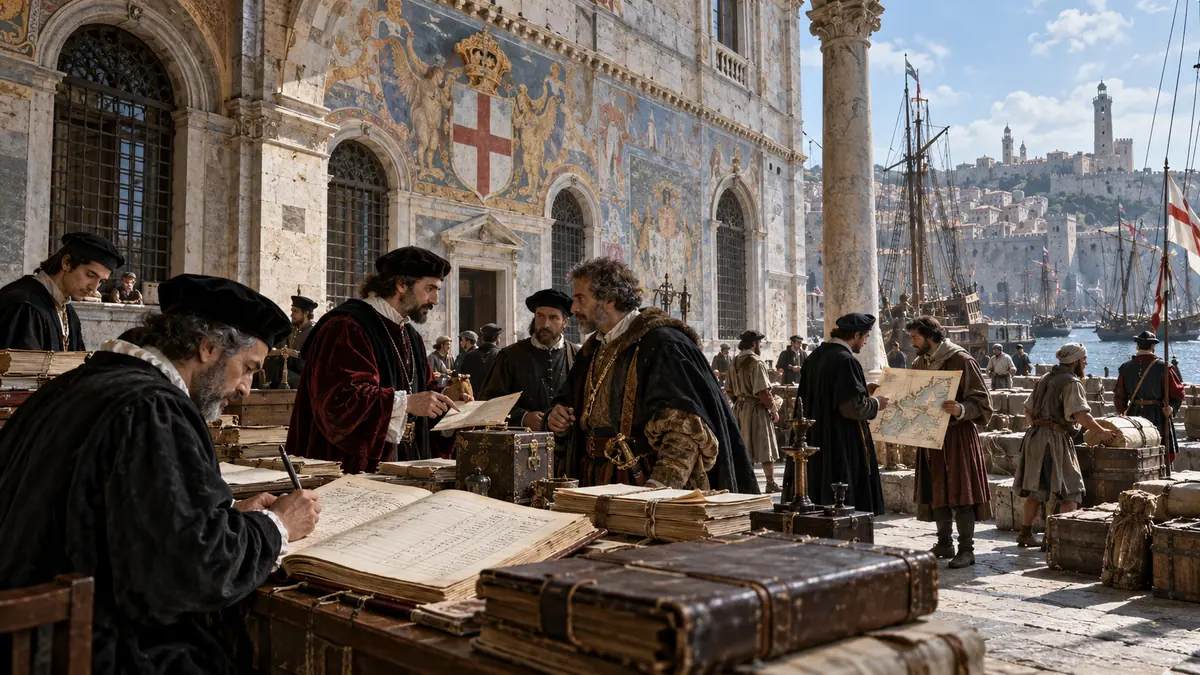
Genoese Bankers and the Spanish Crown: The Financial Network Behind an Empire
Genoese financiers became crucial intermediaries for the Spanish monarchy, moving money across a vast imperial system.
Read article →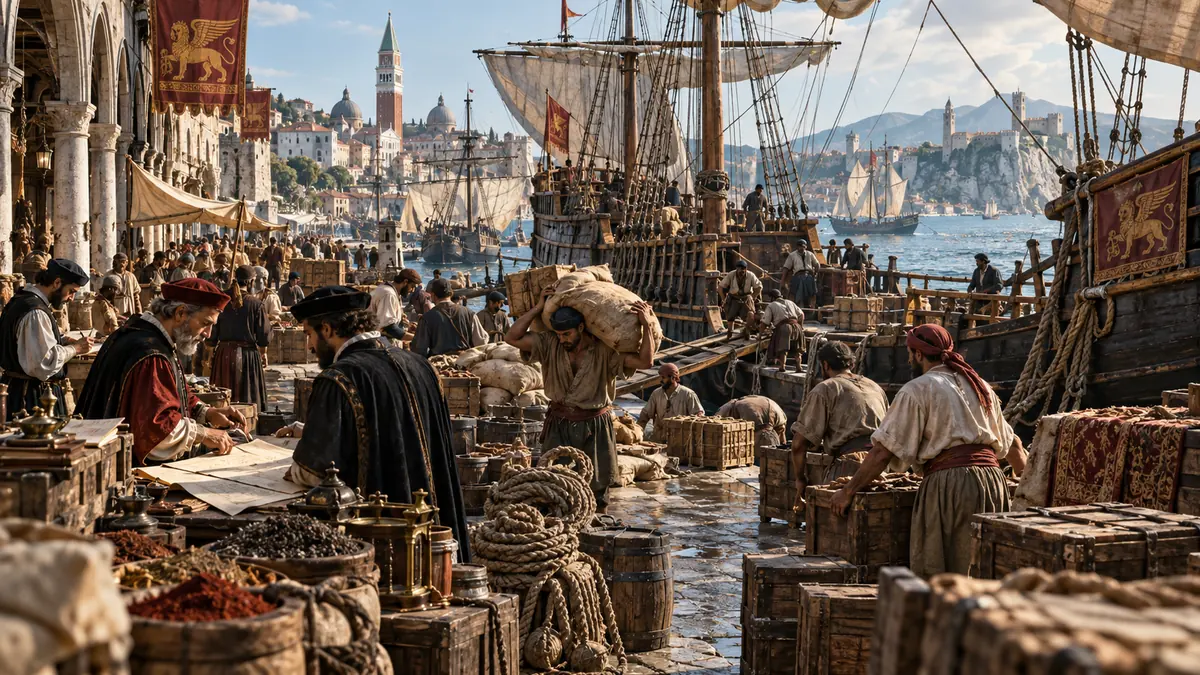
Venice as a Merchant Republic: How Trade Became State Power
Venice turned maritime commerce, shipbuilding, diplomacy, law, and political institutions into a durable commercial state.
Read article →
The Fuggerei: Why Jacob Fugger Built a Social Housing Institution That Survived for Centuries
The Fuggerei tied philanthropy, religion, family memory, and urban housing to a long-lived endowed institution.
Read article →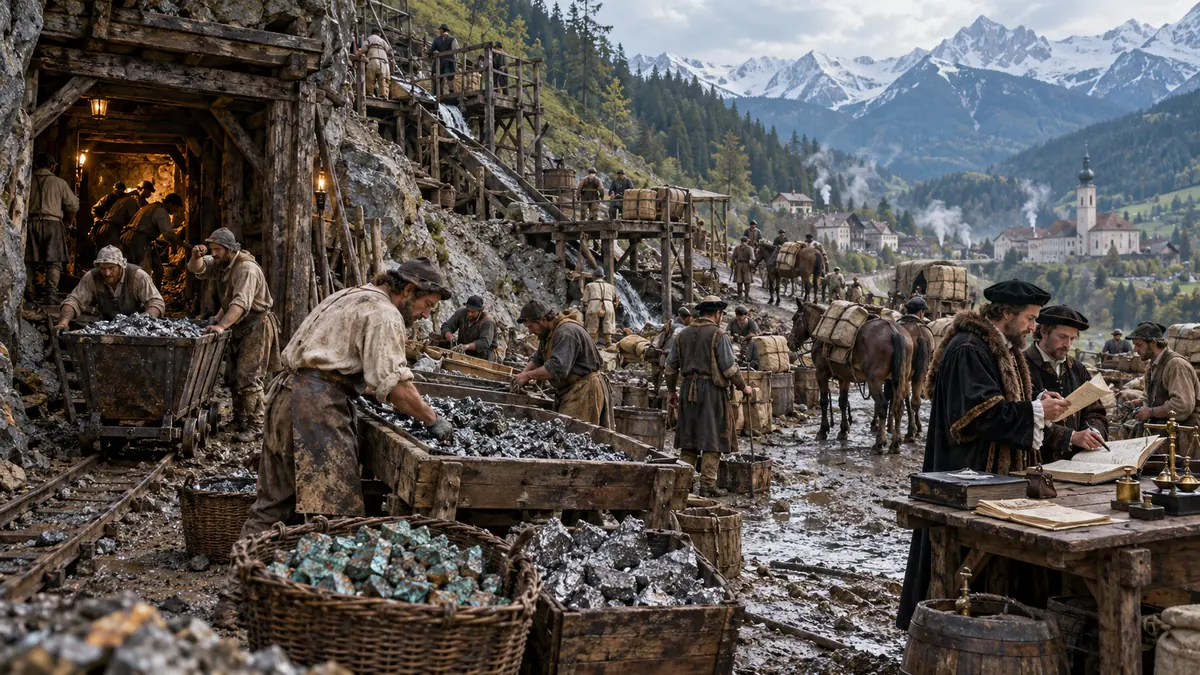
Fugger Mining: How Copper and Silver Became Financial Power
The Fugger enterprise gained leverage by connecting mining rights, production, distribution, and finance across Central Europe.
Read article →