Hadrian and the Roman Empire: Why Consolidation Can Be More Powerful Than Expansion
Hadrian inherited an empire near its greatest territorial extent. His most important strategic choice was not to keep expanding, but to make what Rome already controlled more governable, defensible and durable.
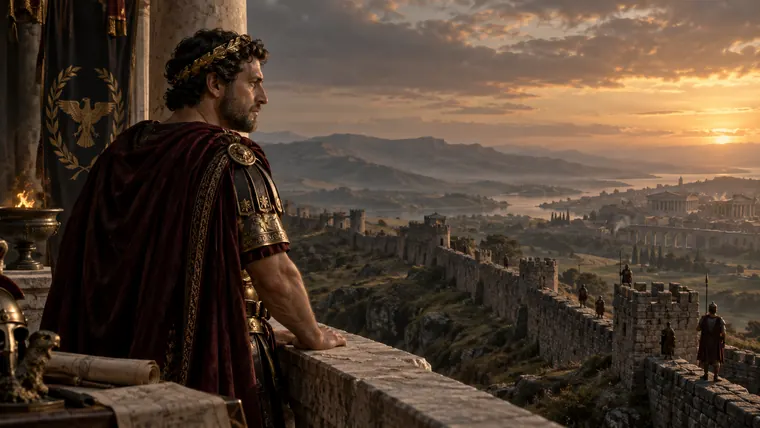
Hadrian’s reign is one of history’s clearest studies in that distinction. He became emperor in 117 CE after Trajan, when Roman power had reached an extraordinary geographic scale. Rather than treating perpetual expansion as the only proof of strength, Hadrian devoted much of his reign to frontiers, administration, travel, military discipline, building projects and the integration of provinces.
The lesson is not that expansion is wrong. It is that growth without integration can turn success into fragility. Durable power depends on the ability to defend, administer, finance and legitimize what you already possess.
Hadrian inherited scale—and the liabilities that came with it
Trajan’s reign had pushed Roman arms deep into new territory. That created prestige, but every new frontier also created costs: garrisons, roads, supply lines, diplomacy, administration and exposure to rebellion. Hadrian’s strategic problem was therefore different from Trajan’s. He did not need to prove that Rome could conquer. He needed to decide what Rome could realistically hold.
This is a recurring leadership problem. Growth changes the job. The founder who once needed aggression may later need systems. The investor who once needed concentration may later need risk control. The operator who once needed speed may later need redundancy and governance. The skill that creates scale is not always the skill that protects it.
Hadrian is often associated with a more defensive posture on Rome’s frontiers. The most famous symbol is Hadrian’s Wall in Britain, whose construction began in 122 CE. A wall is not simply an admission of fear. It can also be a statement of definition: this is the zone we intend to defend, tax, administer and organize.
The strategic shift: from acquisition to integration
Consolidation means converting nominal control into usable capacity. A territory on a map is not yet a functioning system. It needs transport, records, courts, local relationships, tax collection, military supply and enough legitimacy that rule is not maintained by emergency force every day.
Hadrian spent a remarkable portion of his reign traveling through the empire. Ancient and modern accounts emphasize his personal inspection of provinces and armies. That matters because inspection is a form of institutional truth-telling. Reports can flatter. Distance can hide decay. Leaders who only see dashboards eventually mistake representation for reality.
His travels also reveal another principle: integration is local. A central strategy only becomes real when it survives contact with geography, language, logistics and incentives. Rome was not one uniform machine. It was a collection of provinces with different histories and constraints held together by administration, military power, infrastructure and political accommodation.
Borders are not weakness; undefined commitments are
Modern ambition culture often treats boundaries as a failure of nerve. But boundaries are what make commitments credible. A company that says yes to every customer type has no positioning. A manager who accepts every meeting has no priorities. A state that claims every frontier without the resources to defend it has a map, not a strategy.
Hadrian’s frontier policy offers a useful mental model: define the perimeter, then increase the quality inside it. That can mean fortifications, roads, command structures, supply systems or clearer provincial administration. In business, the equivalents are product standards, customer selection, cash discipline, operating procedures and explicit decision rights.
The underlying question is the same: where does our responsibility begin and end? A strategy that refuses to answer that question eventually spends resources everywhere and achieves mastery nowhere.
Infrastructure is strategy made physical
Hadrian is also remembered for major building activity across the empire. Infrastructure is often treated as a secondary result of power, but it can be a source of power. Roads reduce friction. Ports increase throughput. civic buildings project order. Administrative centers standardize decisions. Fortifications reduce the cost of uncertainty.
This logic applies directly to organizations. Infrastructure is everything that makes good behavior easier to repeat: a clean CRM, reliable financial reporting, documented processes, strong onboarding, version control, clear ownership and feedback loops. These systems rarely look heroic. They are what let an organization survive after the heroic phase.
The empire-builder mindset asks, “What can we add?” The institution-builder mindset asks, “What must become reliable?” The second question is usually less exciting and more valuable.
Consolidation does not mean passivity
It would be misleading to describe Hadrian’s reign as peaceful withdrawal. Rome still faced military threats and internal conflict, including the Bar Kokhba revolt in Judea late in his reign. Consolidation can be violent, expensive and politically difficult. It is not the absence of action; it is action directed toward durability rather than headline expansion.
That distinction matters because mature strategy often looks slower from the outside. Paying down operational debt, strengthening compliance, improving product quality, reducing customer churn or upgrading financial controls may produce less immediate applause than launching something new. Yet those choices can increase future freedom.
A strong system earns the right to expand again because it has lower internal fragility.
The Hadrian test for modern leaders
When you are deciding whether to grow, ask five questions. First: what new complexity will this add? Second: what existing weakness will growth amplify? Third: what must become standardized before scale increases? Fourth: what boundary are we unwilling to defend? Fifth: what evidence would tell us that the core is strong enough for the next move?
These questions force ambition to become operational. Growth becomes a capital-allocation decision rather than an emotional reflex.
Hadrian’s enduring strategic value is not that every leader should imitate his choices. It is that he demonstrates a neglected form of ambition: making an existing system stronger, clearer and more governable before demanding that it become larger.
A practical consolidation framework
Use a simple four-part audit. Protect: identify the assets, customers, capabilities or relationships that would be most expensive to lose. Integrate: remove friction between units, teams and systems. Standardize: define the few processes that must work the same way every time. Then expand selectively: add only where the core can support the new load.
The framework works because it treats growth as a consequence of capacity rather than as a substitute for capacity. It also gives ambitious leaders something many lack: permission to strengthen the base without feeling that they have stopped moving.
History rewards expansion with monuments. Institutions survive because somebody did the less glamorous work of consolidation.
Travel as an executive audit, not a ceremonial tour
Hadrian’s extensive travel is one of the strongest parts of his legacy as an administrator. He did not govern only through documents arriving in Rome. He moved through provinces, inspected military units and encountered the practical consequences of imperial policy. For a system as geographically dispersed as Rome, that mattered.
Modern leaders face the same information problem in a different form. Dashboards are summaries. Senior managers receive filtered narratives. Metrics tell you what was measured, not necessarily what is failing. Periodic contact with customers, frontline employees and physical operations acts as an anti-distortion mechanism.
The point is not performative visibility. It is to compare the map with the territory. A leader who never leaves the reporting layer eventually manages a representation of the organization rather than the organization itself.
The hidden economics of saying no
Every frontier creates recurring cost. Every product creates support cost. Every new market creates compliance, localization and managerial cost. Expansion is therefore not a one-time acquisition; it is a stream of future obligations.
Hadrian’s strategic restraint can be read through this economic lens. The relevant question is not whether a new asset can be acquired, but whether its future obligations can be carried without weakening higher-value commitments elsewhere.
This is why disciplined consolidation can increase optionality. By refusing low-quality expansion, a system preserves cash, attention and military or organizational capacity for opportunities that justify the load.
The succession decision: consolidation beyond your own lifetime
Late in life, Hadrian also confronted a problem every durable system eventually faces: succession. After the death of his first adopted heir, Lucius Aelius, Hadrian adopted Antoninus Pius on the condition that Antoninus in turn adopt Marcus Aurelius and Lucius Verus. The arrangement helped create continuity beyond Hadrian’s own reign.
Succession is the final test of consolidation because it asks whether the system can survive the disappearance of the person who currently stabilizes it. A business that only works while the founder personally intervenes in every crisis is not consolidated. It is temporarily held together.
Building successors, decision rights and institutional memory is therefore not separate from growth strategy. It is what turns personal capability into durable organizational capability.
The deeper record behind the thesis
This section goes beyond the headline lesson and looks at the historical record, operating mechanisms, limits and trade-offs that make the subject useful rather than merely inspirational.
A more difficult inheritance than the map suggests
Hadrian came to power in 117 CE at a moment when Rome looked stronger on a map than it necessarily was in practice. Trajan had pushed Roman power into Armenia and Mesopotamia, but territorial acquisition created obligations immediately: garrisons had to be supplied, routes protected, local political relationships managed, and new frontiers defended against Parthian pressure. Hadrian’s early decision to relinquish most of the recent eastern conquests was therefore not simply an ideological rejection of expansion. It was a judgment about what the empire could hold at acceptable cost.
The move was controversial precisely because retreat after victory can look like weakness. Yet strategic control is different from symbolic possession. A province that consumes military resources faster than it produces security, revenue or leverage may enlarge a map while weakening the state behind it. Hadrian’s first major lesson is therefore one of capacity: a system should be judged by what it can sustain, not by the maximum footprint it can briefly claim.
That distinction is highly relevant to modern organizations. New locations, customer segments, products and acquisitions all create recurring obligations. Growth is not the moment of acquisition; it is the years of integration that follow.
The emperor who governed by moving through the system
Hadrian became famous for traveling through the provinces. Modern reconstructions place his major tours across the western and eastern empire between 117 and 133 CE, and his travels occupied a remarkable share of his reign. He visited frontier zones, military installations and major cities rather than governing only from Rome.
In Britain in 122 CE, his visit coincided with the beginning of the frontier system that became known as Hadrian’s Wall. The barrier stretched roughly 118 kilometers across northern Britain and was integrated with milecastles, towers, forts and roads. It was not simply a giant battlefield wall. It controlled movement, supported surveillance, created defensible points and made Rome’s chosen frontier physically legible.
In Africa, Hadrian inspected troops and military discipline. In Greece and the eastern provinces he sponsored civic and architectural projects, negotiated with local communities and reinforced the personal presence of the emperor. The pattern matters: travel was administration, intelligence gathering, symbolism and control at the same time.
Hadrian’s Wall was a management system, not only a monument
Popular images often reduce Hadrian’s Wall to a dramatic line of stone. Operationally, however, the frontier depended on a system of forts, roads, gates, patrols, supply and personnel. A wall without soldiers and logistics would have been an expensive sculpture.
This is a useful correction to how leaders think about systems. A policy document is not a system. A CRM is not a sales process. A dashboard is not management. The visible object only works when roles, incentives, maintenance and feedback surround it.
Frontiers also create information. A defined boundary makes movement observable. Gates create checkpoints. Forts create reporting nodes. In organizational terms, boundaries are valuable not only because they stop activity, but because they make activity measurable.
Military discipline: Hadrian did not confuse peace with softness
Hadrian’s preference for consolidation did not mean neglecting the army. Ancient accounts and later scholarship emphasize his interest in troop inspection, training and readiness. A defensive strategy can fail if it produces complacency; Hadrian’s approach instead combined limited expansion with strong military standards.
This is the strategic paradox: restraint only works when others believe you retain the ability to act. A company can choose not to enter a market because it is disciplined, or because it is incapable. A state can hold a frontier because it prefers stability, or because it has lost initiative. The difference is capacity.
Consolidation therefore requires visible competence. Otherwise restraint is interpreted as decline.
Athens, Hellenism and the cultural side of imperial integration
Hadrian was deeply associated with Greek culture. His patronage in Athens included major building activity and support for institutions intended to bind Greek cities more closely into the imperial order. This cultural policy matters because empires are not held together only by taxes and troops. They also require narratives of belonging.
Roman rule operated over communities with different languages, traditions and civic identities. Hadrian’s philhellenism allowed him to present imperial power in a form that could work with prestigious local culture rather than simply erase it.
The management analogy is straightforward but easy to misuse: integration does not require uniformity. Strong systems define the non-negotiable core while allowing local identity where local identity creates legitimacy and knowledge.
Architecture as imperial communication
Hadrian’s reign is connected with an extraordinary range of construction, from frontier works to temples and his vast villa complex at Tivoli. The Pantheon in Rome, rebuilt under Hadrian, became one of the most durable architectural statements of the Roman world.
Architecture communicates power because it makes coordination visible. A monumental building says that resources, engineering, labor and authority could be organized over time toward a shared outcome. It converts abstract capacity into an experience people can enter.
Modern institutions do the same through products, interfaces, offices, infrastructure and service reliability. Brand is not only what an organization says; it is what its systems make tangible.
The Bar Kokhba Revolt exposes the limits of the consolidation story
A serious account of Hadrian cannot present the reign as a calm administrative success. The Bar Kokhba Revolt in Judaea from 132 to 135/136 CE was a major and destructive conflict. Roman forces faced sustained resistance, and the consequences for the Jewish population and province were severe.
The causes and precise sequence remain subjects of historical debate, including the roles of Roman policy, the refounding of Jerusalem as Aelia Capitolina and religious restrictions. What is not in doubt is that the revolt became one of the hardest crises of Hadrian’s reign.
This complicates simplistic lessons. A leader can be highly capable in administration and still produce or mishandle profound conflict. Strategic competence in one domain does not erase the human consequences of policy in another.
Succession: the ultimate consolidation problem
Hadrian’s final years were dominated partly by succession. His first chosen heir, Lucius Aelius Caesar, died before him. Hadrian then adopted Antoninus Pius in 138 CE on the condition that Antoninus adopt Marcus Aurelius and Lucius Verus. That arrangement helped extend political continuity across subsequent reigns.
Succession reveals whether consolidation reaches beyond the current leader. A founder who strengthens operations but leaves no leadership bench has consolidated processes without consolidating authority.
Hadrian’s reign therefore ends on the same question with which it began: what can the system sustain after the immediate crisis passes?
A chronology worth remembering
117 CE: Hadrian succeeds Trajan and begins reversing some of the most exposed eastern conquests. 121–125: major western and eastern tour. 122: visit to Britain and beginning of Hadrian’s Wall. 128: renewed inspection in North Africa. 128–133/134: second major eastern journey through Greece, Asia Minor, Syria, Judaea and Egypt. 130: Antinous dies in Egypt, followed by the establishment of a cult and city associated with his memory. 132–135/136: Bar Kokhba Revolt. 138: adoption of Antoninus Pius after the death of Aelius Caesar; Hadrian dies later that year.
A chronology prevents the reign from collapsing into one slogan. Hadrian was simultaneously a consolidator, traveler, patron, military ruler, controversial provincial sovereign and succession planner. That complexity is what makes the strategic comparison valuable.
When did Hadrian rule Rome?
Hadrian ruled the Roman Empire from 117 to 138 CE.
Why is Hadrian associated with consolidation?
His reign is strongly associated with frontier definition, provincial travel, military inspection, administration and large building programs rather than continued maximal territorial expansion.
What is the modern leadership lesson from Hadrian?
Growth creates obligations. Leaders should strengthen systems, boundaries and infrastructure before assuming that bigger automatically means stronger.