Cognitive Biases: The Mental Shortcuts That Distort Your Decisions
Biases are not simply signs of low intelligence. They often emerge from normal shortcuts used under uncertainty, time pressure, incomplete information, and social influence.
Cognitive biases are systematic patterns that can distort judgment. Understanding them helps—but debiasing requires better processes, not just memorizing a list of bias names.
This guide focuses on the mechanism behind the idea rather than on slogans. The goal is to make the concept useful enough to apply, while keeping the limits and assumptions visible.

1. What Cognitive Bias Means
A cognitive bias is a systematic tendency in judgment that can lead people away from a relevant standard of reasoning, evidence, or probability. Biases are often linked to heuristics—simplified strategies that make complex decisions faster and less mentally expensive.
The important nuance is that shortcuts are not always bad. In many environments, fast pattern recognition is useful. Problems emerge when a shortcut is applied in a setting where its assumptions do not hold.
2. Anchoring: The First Number Can Pull the Rest of the Judgment
Anchoring occurs when an initial value, estimate, or reference point influences later judgment more than it should. Negotiations, pricing, forecasting, and planning are all vulnerable. Once a number is on the table, subsequent estimates often move around it instead of being rebuilt from independent evidence.
A practical defense is to create an outside-view estimate before seeing someone else’s number. In teams, ask multiple people to estimate independently before discussion begins.
3. Availability: What Comes to Mind Feels More Common
Events that are vivid, recent, emotionally charged, or repeatedly discussed can feel more probable than they are. A dramatic failure may dominate risk discussions even when base rates suggest another threat is more common. A recent success can create the opposite problem.
This is one reason the broader psychology of human behavior cannot be understood from introspection alone. What feels salient is not necessarily what is statistically representative.
4. Confirmation Bias: Evidence Search Can Become Evidence Selection
Once people favor a hypothesis, they may search for information that supports it, interpret ambiguity in its favor, or scrutinize opposing evidence more aggressively. The effect is especially dangerous when identity, reputation, or sunk effort is involved.
- Write down what evidence would change your mind before collecting more evidence.
- Assign someone to build the strongest opposing case.
- Separate “evidence for” from “evidence against” in the same review.
- Track forecasts so memory cannot quietly rewrite what you originally expected.
5. Overconfidence: Certainty Often Grows Faster Than Accuracy
Reviews of professional decision making repeatedly identify overconfidence as a recurring concern. Expertise can improve judgment, but it can also create environments where people stop expressing uncertainty. The question is not whether a person is confident; it is whether confidence is calibrated to actual predictive accuracy.
Use probability ranges, confidence intervals, scenario bands, or explicit “what would surprise us?” questions instead of forcing a single precise prediction.
6. Bias Lists Do Not Automatically Debias You
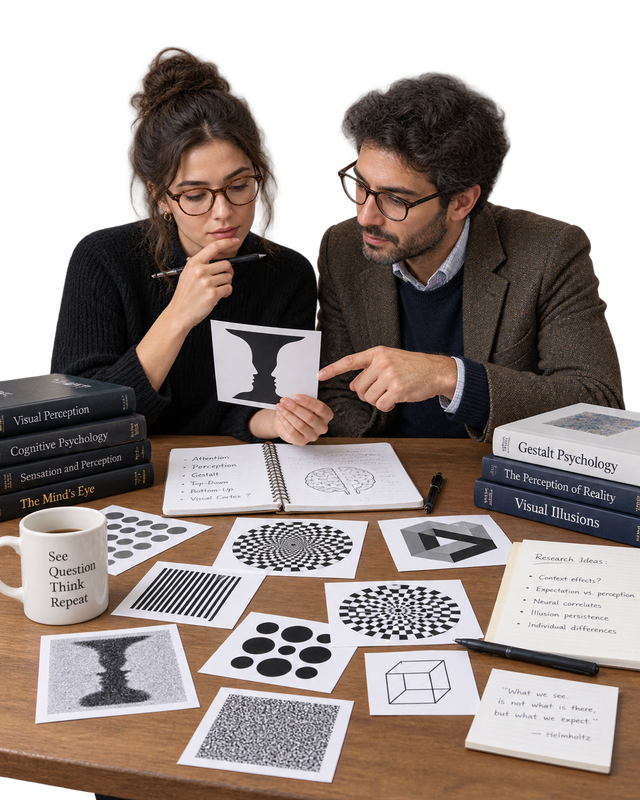
Learning bias names can create a new illusion: the belief that awareness makes you immune. People often identify biases more easily in others than in themselves. Better decision processes create friction against predictable errors even when nobody notices the bias in real time.
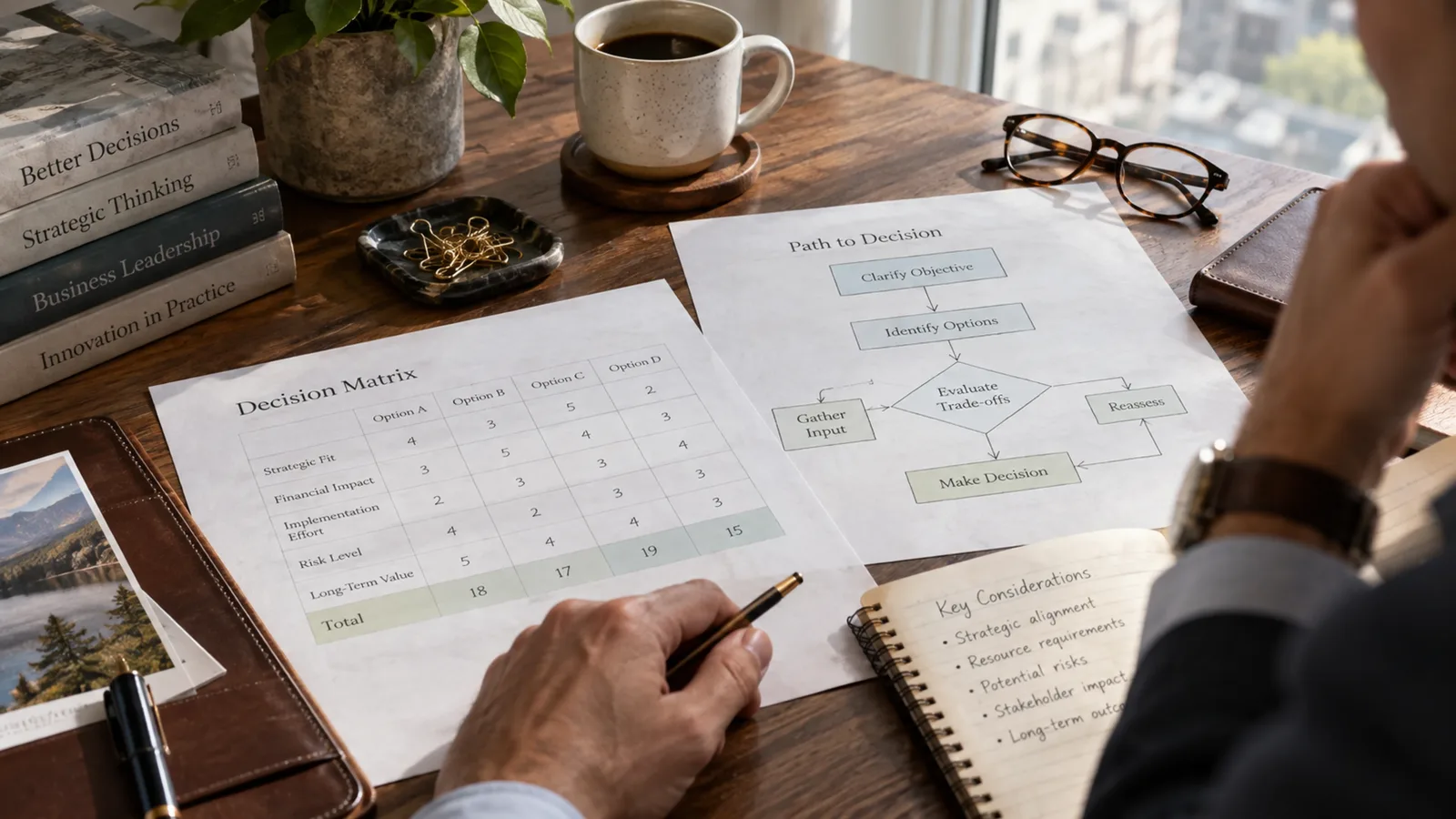
Useful tools include independent estimates, checklists, pre-mortems, base-rate research, decision journals, red teams, and structured decision matrices. The common feature is that they change the environment around the decision.
7. Bias Is Not an Excuse to Distrust Every Intuition
Intuition can reflect real learning when a person has repeated exposure to a stable environment with fast, accurate feedback. The danger is transferring intuitive confidence into noisy systems where feedback is delayed or outcomes are driven by hidden variables.
The aim is not to become paralyzed by the possibility of bias. It is to match the decision process to the stakes, uncertainty, and reversibility of the choice—one of the central ideas in our decision-making models guide.
Key Takeaways
- Cognitive biases are systematic patterns, not simply random mistakes.
- Heuristics can be useful; problems emerge when the shortcut does not fit the environment.
- Anchoring, availability, confirmation bias, and overconfidence can distort professional decisions.
- Knowing bias names is weaker than changing the process around the decision.
- Independent estimates, base rates, pre-mortems, and decision journals can create useful friction.
Frequently Asked Questions
Are cognitive biases the same as being irrational?
Not exactly. Many biases arise from normal information-processing shortcuts that are efficient in some contexts but systematically misleading in others.
Can experts still have cognitive biases?
Yes. Expertise can improve accuracy while leaving people vulnerable to anchoring, overconfidence, availability, or other biases, especially in uncertain environments.
What is the best way to reduce bias?
There is no universal fix. Structured processes such as independent estimates, checklists, base-rate comparisons, pre-mortems, and decision logs are often more reliable than awareness alone.