Roman Empire Artifacts: What Coins, Inscriptions, Pottery, Tools, and Everyday Objects Reveal
Roman artifacts provide evidence about economic life, identity, religion, military service, trade, literacy, status, and daily routines that literary histories often overlook.
1. The core idea
Roman artifacts provide evidence about economic life, identity, religion, military service, trade, literacy, status, and daily routines that literary histories often overlook.
The useful version of roman empire artifacts begins with precision. A keyword can describe several different ideas at once, so the first task is to identify the mechanism, time period, decision, or historical claim being discussed.
2. The most important facts
The following points form the backbone of the topic. Each one changes how the subject should be interpreted, applied, or measured.
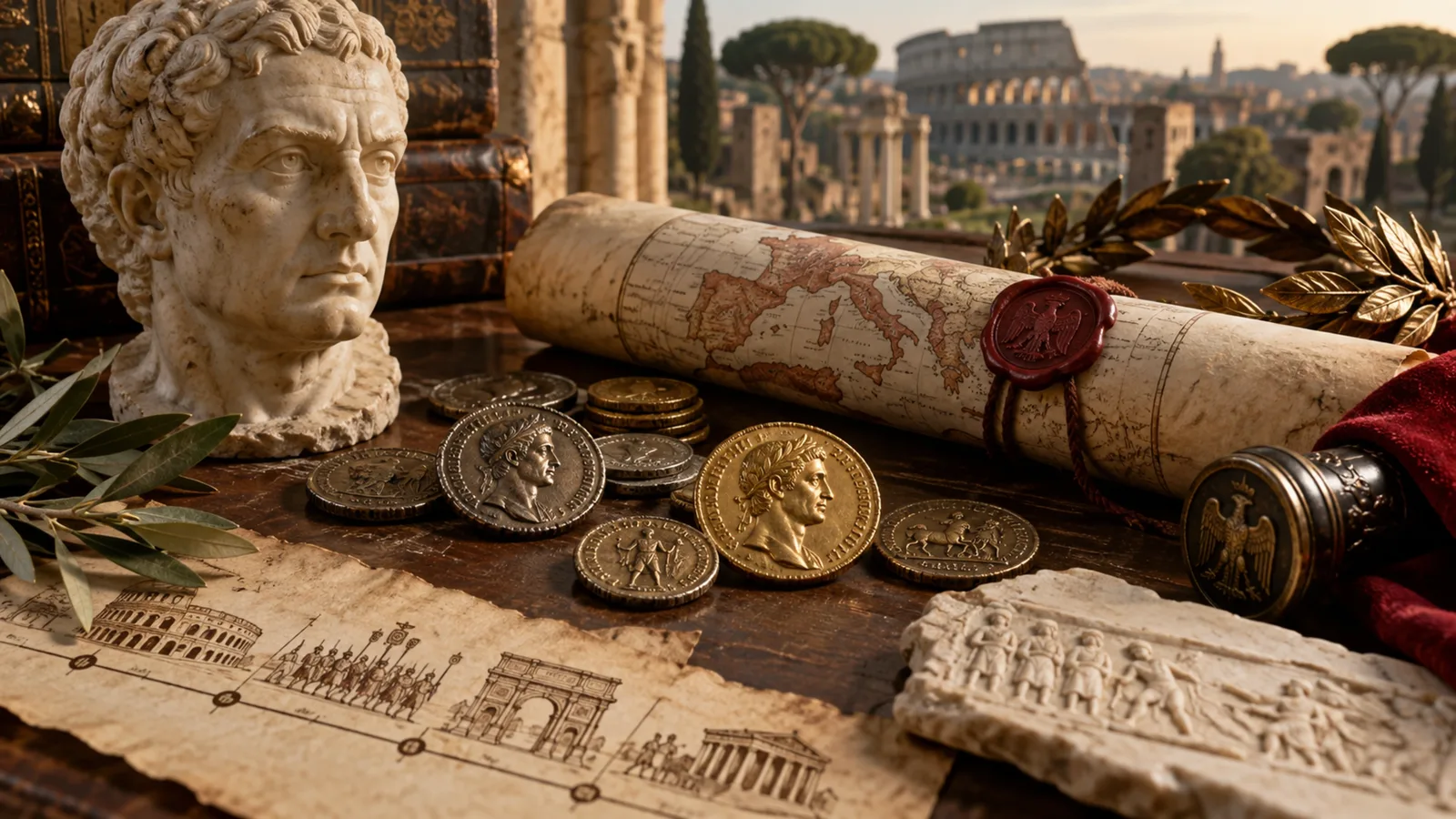
- Coins carry portraits, titles, deities, victories, and political messages as well as monetary value.
- Inscriptions reveal careers, dedications, military units, civic offices, funerary identities, and legal status.
- Pottery distributions help archaeologists reconstruct trade and consumption networks.
- Small finds such as writing tablets, shoes, jewelry, tools, and household objects expose daily life.
- Archaeological context matters: an artifact removed from its layer loses much of its evidentiary value.
1. Coins carry portraits, titles, deities, victories, and political messages as well as monetary value.
This point matters because it changes how roman empire artifacts should be understood. Taken in isolation, the fact can be oversimplified; placed in the wider system, it reveals the mechanism, historical constraint, or economic relationship that gives the topic meaning.
2. Inscriptions reveal careers, dedications, military units, civic offices, funerary identities, and legal status.
3. Pottery distributions help archaeologists reconstruct trade and consumption networks.
4. Small finds such as writing tablets, shoes, jewelry, tools, and household objects expose daily life.
5. Archaeological context matters: an artifact removed from its layer loses much of its evidentiary value.
3. Why the simple version is often wrong
Ancient evidence is incomplete, uneven, elite-heavy, and often written for rhetorical or political purposes. Archaeology and documents can correct or complicate literary narratives.
Simplified explanations are attractive because they create a clean story. Richer analysis usually shows boundary conditions, trade-offs, conflicting evidence, or differences across time and context.
4. A concrete example
The Vindolanda tablets preserve ordinary military and household communications near Hadrian’s Wall.
Amphora stamps and ceramic typologies help trace production and long-distance exchange.
A good example is not decorative. It reveals how the mechanism behaves when incentives, institutions, constraints, or human judgment become visible.
5. How to analyze the topic properly
Treat every claim as a question of period, region, evidence type, and institutional context.
The next step is to separate evidence from interpretation. Write what is directly observed or documented, then identify the inference required to reach the conclusion. This makes uncertainty easier to see.
6. Common misconceptions
Misconceptions often survive because they are memorable, emotionally satisfying, or useful in short-form content. Correcting them requires more than replacing one slogan with another; it requires explaining why the tempting version is incomplete.
Misconception 1: the simplified opposite of the evidence
A common mistake is to ignore the implication of this fact: Coins carry portraits, titles, deities, victories, and political messages as well as monetary value. The correction is not to memorize a replacement slogan, but to understand why the underlying evidence forces a more qualified conclusion.
Misconception 2: the simplified opposite of the evidence
A common mistake is to ignore the implication of this fact: Inscriptions reveal careers, dedications, military units, civic offices, funerary identities, and legal status. The correction is not to memorize a replacement slogan, but to understand why the underlying evidence forces a more qualified conclusion.
Misconception 3: the simplified opposite of the evidence
A common mistake is to ignore the implication of this fact: Pottery distributions help archaeologists reconstruct trade and consumption networks. The correction is not to memorize a replacement slogan, but to understand why the underlying evidence forces a more qualified conclusion.
7. Trade-offs and boundary conditions
Every useful concept has conditions under which it works poorly, changes meaning, or creates a different outcome. Those boundary conditions are part of the concept rather than exceptions to be ignored.
The practical lesson is to ask not only whether the idea is true, but true for whom, when, at what scale, under which assumptions, and compared with what alternative.
8. Evidence quality
Evidence should be weighted by what it can actually support. Primary texts can reveal what an ancient author wrote but not automatically describe an entire society. Accounting statements can show reported performance but not every economic reality. Consumer behavior studies can identify average effects without predicting every individual.
Strong analysis combines multiple forms of evidence where possible and states uncertainty where the record is incomplete.
9. Second-order effects
The first-order result is often obvious. The second-order result emerges after people adapt, expectations change, incentives shift, or the initial decision alters the environment.
For roman empire artifacts, second-order thinking asks what the system looks like after the first response has already happened.
10. A practical framework
Use four questions: What is the claim? What evidence supports it? What alternative explanation exists? What decision or interpretation changes if the claim is correct?
This structure works for philosophy, history, business, and behavior because it forces the article to move from description to judgment without pretending certainty where none exists.
11. What to compare it with
Comparison improves understanding because definitions become clearer at the boundary. Compare the concept with its nearest alternative, opposite, substitute, historical rival, or adjacent metric.
The goal is not to manufacture a winner but to show which question each concept answers and what it leaves out.
12. What this means in practice
Treat every claim as a question of period, region, evidence type, and institutional context.
Application should preserve the logic of the original concept. When a historical or philosophical idea is adapted to modern life, the adaptation should be labeled rather than presented as if the ancient source explicitly described modern work, finance, or technology.
13. Questions worth asking next
What evidence would make the current explanation less convincing? Which assumption is doing the most work? Is the most visible example actually representative? What changes across time, geography, customer segment, or institutional setting?
These questions make the article a starting point for deeper understanding rather than a terminal answer.
14. Deep-dive: how the pieces fit together
To understand roman empire artifacts at a deeper level, connect the facts rather than reading them as isolated trivia. Coins carry portraits, titles, deities, victories, and political messages as well as monetary value. At the same time, inscriptions reveal careers, dedications, military units, civic offices, funerary identities, and legal status. Those two points interact with a third constraint: pottery distributions help archaeologists reconstruct trade and consumption networks. The combined picture is more useful than any single statement because it shows why outcomes change when context changes.
The fourth and fifth points add the boundary conditions: Small finds such as writing tablets, shoes, jewelry, tools, and household objects expose daily life. Archaeological context matters: an artifact removed from its layer loses much of its evidentiary value. This is where many shallow explanations fail. They select the most dramatic feature and omit the conditions that determine whether it matters.
15. A diagnostic checklist
- Define the term before arguing about it.
- Identify the relevant time period, unit, population, or decision.
- Separate direct evidence from inference.
- Look for the strongest alternative explanation.
- State the most important limitation.
- Connect the conclusion to a real decision or interpretation.
A checklist is valuable because it creates repeatability. It reduces the chance that one memorable example, favored author, attractive metric, or cultural stereotype will dominate the analysis.
Research & Application Appendix 1
Start with a one-page note on roman empire artifacts. In the first paragraph, define the term without examples. In the second, list the evidence. In the third, state the strongest limitation. In the fourth, explain the practical or historical implication. This format forces clarity because definition, evidence, and interpretation cannot hide inside the same sentence.
Next, build a comparison table on paper. Put the focal concept in one column and its closest alternative in another. Compare purpose, mechanism, evidence, strengths, limitations, and failure modes. Many apparent disagreements disappear once two concepts are shown to answer different questions.
Then create a counterexample. Ask for a case in which the simple rule would fail. Counterexamples are powerful because they reveal hidden assumptions. They do not automatically disprove the concept; they show where additional conditions are needed.
Finally, write the update rule. What new evidence would cause you to change the conclusion? Without an update rule, research can become confirmation rather than inquiry. A serious reference article should make revision possible.
Research & Application Appendix 2
Research & Application Appendix 3
Research & Application Appendix 4
Research & Application Appendix 5
Research & Application Appendix 6
Research & Application Appendix 7
Research & Application Appendix 8
Research & Application Appendix 9
Research & Application Appendix 10
Research & Application Appendix 11
Research & Application Appendix 12
Research & Application Appendix 13
Research & Application Appendix 14
Research & Application Appendix 15
Research & Application Appendix 16
Research & Application Appendix 17
Frequently Asked Questions
What is roman empire artifacts?
Roman artifacts provide evidence about economic life, identity, religion, military service, trade, literacy, status, and daily routines that literary histories often overlook.
Why does roman empire artifacts matter?
It matters because it changes how the subject is interpreted, measured, or applied. The strongest understanding comes from the mechanism and evidence, not the label alone.
What is often misunderstood about roman empire artifacts?
One frequent problem is reducing the topic to a single slogan while ignoring context, evidence quality, and boundary conditions.
How should a beginner approach roman empire artifacts?
Start with the definition, then read primary or foundational sources, examine a concrete example, and compare competing interpretations before trying to apply the idea.
What is the main limitation of a simple explanation?
Ancient evidence is incomplete, uneven, elite-heavy, and often written for rhetorical or political purposes. Archaeology and documents can correct or complicate literary narratives.
Sources and Further Reading
- Vindolanda tablet publications
- Roman numismatics scholarship
- Corpus Inscriptionum Latinarum
- Archaeological context methodology