The Roman Empire: How Power, Logistics and Institutions Built a Civilization
Rome’s power did not rest on armies alone. The empire worked because military force was connected to roads, ports, grain supply, administration, law, taxation and a network of institutions.
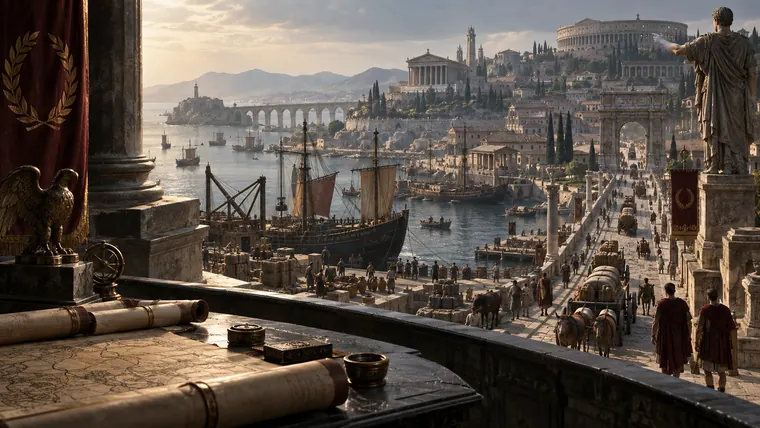
Armies had to be fed. Cities had to receive grain. Taxes had to be collected. Orders had to move. Ports needed warehouses. Roads needed maintenance. Provincial elites had to cooperate. A territory spanning Europe, North Africa and Western Asia could not be held together by spectacle alone.
Rome’s real achievement was not simply conquest. It was the creation of a network that converted conquest into recurring administration.
Military power depended on supply
A legion is impressive on a battlefield and helpless without food, equipment, animals, engineers and replacement material. Roman military success depended heavily on organized logistics.
Roman forces included more than infantry. Marching armies relied on cavalry, auxiliaries, engineers, surveyors, craftsmen, baggage animals and supply personnel. Fortified camps and warehouses allowed armies to store provisions rather than depend entirely on immediate local foraging.
The lesson is elementary and often ignored: front-end capability is limited by back-end support. Every visible achievement has a supply chain.
Roads reduced the cost of control
Roman public roads eventually formed an enormous network. World History Encyclopedia estimates more than 120,000 kilometers of public roads, connecting regions and allowing troops, officials, messages and goods to move with greater reliability.
Roads were military infrastructure, commercial infrastructure and political infrastructure at the same time. They reduced response time, increased administrative reach and made imperial authority physically present.
In modern terms, the road network functioned like a platform. Once built, many different users could create value on top of it.
The Mediterranean was a transport system
Rome’s connectivity also depended on sea routes. Bulk transport by water was far cheaper than moving heavy goods over land. Grain, wine, olive oil, metals and other commodities moved through ports and maritime networks at enormous scale.
That matters because large cities require flows larger than local production can provide. Rome itself depended on imported grain and other supplies. Keeping the capital fed was a strategic problem, not a retail detail.
The empire therefore operated through a mixed network of roads, rivers and sea lanes, each used according to cost, geography and season.
The annona shows what scale really requires
Imperial authorities developed systems to help secure regular grain supply. The annona was not merely welfare in the modern sense; it was part of urban stability and state logistics.
Food shortages could become political crises. That made supply a matter of legitimacy. A government that could project military power but could not feed the capital would not feel powerful for long.
This is one of Rome’s most modern lessons: reliability is political. Customers, citizens and employees judge systems by whether essential things arrive when expected.
Institutions multiplied the reach of the center
No emperor could personally govern every town, adjudicate every dispute or inspect every road. Rome relied on governors, municipal elites, military commands, tax systems and legal practices that distributed administrative work.
Institutions allow a center to act at a distance. They make decisions repeatable without requiring the presence of the founder.
That is why institution building is a form of leverage. It turns individual authority into organizational capacity.
Standardization and local adaptation coexisted
The Roman world was culturally diverse. Latin was important in the West, Greek remained dominant across much of the East, and local religions, customs and elites persisted.
Rome did not create one uniform culture. Its strength often came from combining imperial frameworks with local administration and existing networks.
This hybrid model is useful for any organization operating across regions: standardize what creates interoperability; adapt what depends on local knowledge.
Infrastructure also communicated ideology
Roads, arches, forums, baths, temples and aqueducts were functional, but they were also messages. They made imperial capacity visible.
Power becomes more credible when people can experience its outputs. Infrastructure tells a story without a speech: someone can coordinate labor, finance, engineering and maintenance at scale.
That is why neglected infrastructure eventually becomes a legitimacy problem. Physical decay reveals institutional decay.
What Rome teaches modern operators
Look beneath visible performance. Ask what network makes it possible. Where are the bottlenecks? Which flows are fragile? What breaks if one node fails?
For a digital company, logistics may mean cloud infrastructure, payments, support and data pipelines. For a local business, it may mean lead routing, inventory, scheduling and cash collection. The details differ; the systems logic is the same.
Empire is a dramatic word. Operations is not. But Rome’s history shows that operations are what make scale real.
Ports and warehouses were as important as roads
Roads dominate popular imagination because they are visible and durable. But maritime transport carried bulk goods at far lower cost, making ports essential nodes in the imperial economy.
Warehouses near military camps and commercial centers turned transport into dependable supply. The flow had to be received, stored, recorded and redistributed.
Networks create value only when nodes can handle what arrives. Building the road without building the receiving system merely moves the bottleneck.
Taxation converted territory into state capacity
Conquest expanded Rome’s tax base, but taxes had to be assessed, collected and transmitted. Administrative capacity turned geographic control into recurring resources.
This is the difference between owning an asset and operating an asset. Revenue that cannot be measured or collected is theoretical.
Modern businesses face the same distinction. Sales booked without collections, inventory controls or margin visibility can create impressive growth and weak cash flow.
Institutional resilience is different from imperial permanence
Rome’s infrastructure and administrative methods were powerful, but the Western Empire still fragmented. Systems can be sophisticated and still fail under combined military, fiscal, political and demographic stress.
That is an important corrective to simplistic “Rome was efficient” narratives. No system is protected from accumulated shocks merely because its institutions were once excellent.
Resilience requires maintenance, adaptation and the willingness to redesign before legacy systems become liabilities.
Money and coinage created a common language of exchange
Coinage was not uniform in every local context, but imperial currency helped taxes, military pay and commerce operate across a vast geographic area. Coins also carried imperial imagery, joining economic function with political communication.
A shared medium of exchange reduces transaction friction. It lets distant participants price, pay and account within a common framework.
Modern platforms do the same when they standardize identity, payment, data formats or rules. Interoperability is an economic force.
Cities were nodes in the imperial network
Roman power was not exercised only from Rome. Provincial cities, colonies and municipal governments acted as administrative and commercial nodes.
Local elites often participated in governance, public building and tax collection. This distributed some of the cost of administration while tying local status to imperial order.
Networks scale when peripheral nodes have both capability and incentive. Centralization without capable local execution creates delay; decentralization without standards creates fragmentation.
Law reduced some forms of uncertainty
Roman law evolved over centuries and was far from uniform in every province or period, but legal procedures, contracts, citizenship categories and property rules provided frameworks that made social and commercial expectations more predictable.
Predictability is economically valuable. People invest more confidently when ownership, obligation and dispute resolution are legible.
In organizations, policy and decision rights play the same role. Rules are not valuable because bureaucracy is beautiful. They are valuable when they reduce costly ambiguity.
Communication speed shaped imperial decision making
Orders moved no faster than ships, horses and roads allowed. That meant provincial governors and commanders needed discretion. The center could not micromanage events in real time.
Slow communication forced a balance between standard rules and delegated authority. Rome needed representatives capable of acting without waiting for instant approval.
Modern companies have faster communication but often recreate the opposite problem: because the center can intervene constantly, local judgment atrophies. Technology can increase control while reducing initiative.
Maintenance is the invisible half of infrastructure
Building a road or aqueduct creates political credit. Maintaining it for decades creates capacity. The second task is less visible and often more important.
Every system accumulates maintenance debt. Software becomes brittle, roads deteriorate, procedures become obsolete, teams forget why controls exist.
Rome’s longevity depended not only on engineering breakthroughs but on repeated repair and administration. Durable organizations budget for maintenance before failure makes it urgent.
Scale amplifies coordination problems
A local town can solve many problems informally. An empire cannot. Scale creates distance between cause and consequence, between the person making policy and the person experiencing it.
Institutions exist partly to manage that distance. Reporting, law, hierarchy, standards and infrastructure are coordination technologies.
The larger the system becomes, the more important it is to know which decisions must be centralized, which should be standardized and which need local adaptation.
Why the Roman system eventually became harder to carry
The Roman Empire changed repeatedly over centuries, and no single explanation accounts for the Western Empire’s fragmentation. Military pressure, fiscal strain, civil conflict, demographic shocks and political instability interacted in complex ways.
This is precisely the systems lesson. Large failures rarely come from one broken component. They emerge when multiple stresses reinforce one another faster than institutions can adapt.
Studying Rome well means resisting one-cause stories. Complex systems require multi-causal thinking.
The army was also an engineering organization
Roman soldiers did not only fight. Military units built roads, camps, bridges and frontier installations. Engineering capability reduced dependence on external contractors and allowed the army to create the infrastructure it needed to move and survive.
This is a useful organizational pattern: the team closest to a recurring bottleneck often benefits from having enough capability to solve part of it directly.
Dependence is not always bad, but critical capabilities should not become mysterious black boxes.
The empire depended on information flows
Governors reported conditions, commanders sent dispatches, tax records moved through administrative chains and imperial decisions traveled outward.
Information was slower and less complete than modern data, which made judgment and trust essential. A report could be delayed, distorted or outdated by the time it reached the center.
Today information is faster but distortion still exists. The modern challenge is not scarcity of reports; it is separating signal from noise.
Urban scale required water, sanitation and public works
A large city cannot function on political authority alone. Water supply, drainage, roads, marketplaces and public buildings are operational systems.
Roman aqueducts are famous because they made urban density more manageable. The broader point is that civilization depends on invisible recurring services, not only monumental events.
When essential systems work, people stop noticing them. That invisibility is often the mark of successful infrastructure.
Trade networks created specialization
When transport and legal frameworks connect regions, production can become more specialized. One area can export olive oil, another grain, another metals or manufactured goods.
Specialization increases productivity but also increases interdependence. A shock in transport, security or currency can travel across the network.
Scale therefore creates both efficiency and systemic risk. The better connected the network, the more important resilience becomes.
Rome’s greatest operating lesson is not 'centralize everything'
The empire combined central authority with substantial local administration. That balance shifted across periods, but the system could not function if every minor matter waited for Rome.
Modern organizations often centralize because they can, not because they should. Digital communication makes central intervention cheap, which can quietly destroy local ownership.
A stronger design asks which decisions benefit from common standards and which require proximity to local information.
The deeper record behind the thesis
This section goes beyond the headline lesson and looks at the historical record, operating mechanisms, limits and trade-offs that make the subject useful rather than merely inspirational.
Rome’s road network was a military and administrative platform
Roman roads are famous for straight alignments, bridges and durable construction, but their strategic value was movement. Public roads linked military zones, provincial capitals, ports and cities across tens of thousands of kilometers.
World History Encyclopedia estimates more than 120,000 kilometers of public Roman roads. The scale matters because roads lowered the time cost of sending troops, officials, messages and goods across a huge territory.
Once infrastructure exists, multiple functions can ride on it. That is why platform infrastructure produces more value than a single-purpose project.
The Via Appia shows what infrastructure commitment looked like
The Via Appia began in 312 BCE and eventually linked Rome toward southern Italy and Brundisium. Its directness required significant engineering and made it one of the most famous roads in the Roman world.
Long before the imperial period, Roman elites had already learned that roads could convert political and military objectives into physical geography.
Infrastructure changes the future decision set. Once a route exists, troop movements, trade and settlement patterns become possible at lower cost.
Sea transport did the heavy economic lifting
Rome’s roads deserve their reputation, but moving bulk goods over land remained expensive. Historical estimates cited by World History Encyclopedia give an approximate transport-cost ratio of 1 by sea, 5 by river and 28 by land.
That helps explain why the Mediterranean was not a border around the empire. It was a transport system inside it. Grain, wine, olive oil, ceramics, metals and luxury goods moved across maritime routes in enormous quantities.
The Roman economy therefore depended on a network, not on one technology: roads for access and military movement, rivers where geography allowed, and sea lanes for high-volume long-distance trade.
Ostia, Portus and the logistics of feeding a megacity
Rome’s population required food flows that the surrounding countryside could not reliably supply at sufficient scale. The ports connected the capital to grain-producing regions such as Egypt and North Africa.
Warehouses, docks, river transport and administrative oversight converted maritime arrival into urban supply. The annona system and the office of the praefectus annonae were central to managing grain distribution and supply security.
This is operations at civilizational scale. The glamorous object is the capital city; the survival mechanism is a chain of ships, contracts, storage and distribution.
The annona was also a legitimacy system
Food supply is political because failure becomes visible immediately. A government able to conquer provinces but unable to stabilize bread supply would quickly reveal the gap between military prestige and administrative competence.
Rome’s intervention in grain transport included regulation and incentives for shipping. The state did not simply hope markets would solve every emergency independently.
The broader principle is that essential services create legitimacy through reliability. People may not understand the architecture of the system, but they understand when it fails.
Military logistics explain why Rome cared about roads, depots and frontiers
Legions required grain, animals, weapons, clothing, pay, replacements and engineering materials. Campaigns that look like battlefield stories were sustained by supply systems operating behind the front.
Forts and depots created storage points. Roads allowed wheeled supply. Rivers and sea routes moved heavier loads. Local requisition and provincial production supplemented longer supply chains.
Military history becomes much more intelligible once logistics is treated as strategy rather than background.
The cursus publicus turned roads into an information network
Imperial administration also depended on official communications. Relay systems of stations and authorized transport allowed messages and officials to move through the empire more efficiently than ordinary private travel.
Information speed determines management speed. A governor on a distant frontier could not wait for continuous instructions from Rome, which meant local judgment remained essential.
Modern communication has reversed the technical constraint without eliminating the organizational question: just because headquarters can intervene instantly does not mean it should.
Taxation converted territory into recurring state capacity
Territory is economically useful to a state when resources can be assessed and collected. Roman provincial taxation changed across periods, but the imperial system relied on census, land assessment, customs duties and other revenues to finance administration and military expenditure.
Augustan reforms pushed parts of this system toward greater regularity. Later emperors continued to modify it.
The general operating lesson is simple: revenue without measurement is fragile. States and businesses both require visibility into the resources they claim to control.
Coinage was money, propaganda and interoperability
Roman coins made exchange easier across a geographically diverse world while also carrying portraits, titles and political messages. Currency therefore served both economic and ideological functions.
A common monetary framework reduces the friction of pricing and payment, although local variation and debasement across periods complicate any simple picture of monetary uniformity.
In platform terms, currency is a shared protocol. It allows strangers to transact inside a common system.
Cities were operating nodes, not passive possessions
Provincial cities and local elites carried much of the work of administration. Municipal institutions, councils and wealthy local patrons helped manage public works, taxes, religious life and civic order.
This distributed model reduced the need for a massive central bureaucracy. Rome often governed through local structures rather than replacing every local institution with officials from the capital.
Scale becomes cheaper when nodes possess both incentive and capability.
Law reduced some forms of transaction uncertainty
Roman law evolved continuously and differed across status, province and period, but legal frameworks for property, contracts, citizenship and dispute helped make interactions more predictable.
Predictability encourages long-term exchange because participants have a clearer idea of how obligations will be interpreted.
Institutions create economic value when they reduce the number of questions that must be renegotiated from zero.
Aqueducts, water and the operational reality of urban scale
Large cities require recurring water supply. Roman aqueducts, distribution systems and public fountains supported urban density, baths and sanitation practices that would be impossible at the same scale without engineered water flow.
These systems also required inspection, repair and administration. Monumental engineering only survives when maintenance becomes routine.
This distinction—construction versus maintenance—is one of Rome’s strongest lessons for modern infrastructure.
Maintenance is the invisible half of civilization
Roads crack, ports silt, walls deteriorate, records become outdated and organizations forget why procedures exist. Every system accumulates maintenance debt.
Roman infrastructure endured for centuries because generations repaired and reused it, not because the original builders created immortal objects.
Leaders who budget only for creation eventually inherit impressive systems that no longer work.
Global trade reached far beyond the imperial frontier
Roman commercial networks connected with Arabia, East Africa, Central Asia and India through the Red Sea, Persian Gulf and overland routes. Luxury goods such as spices, textiles and precious materials traveled through multiple political jurisdictions.
Long-distance commerce depended on merchants, financiers, caravan operators, ports and intermediaries whose incentives did not align automatically with imperial strategy.
This reminds us that even powerful states depend on networks they do not fully control.
Why one-cause explanations of Roman decline are weak
The Western Roman Empire did not collapse because one road failed or one emperor made one mistake. Military pressure, civil wars, fiscal strain, demographic shocks, political instability and structural change interacted over long periods.
Complex systems often fail through feedback loops. A fiscal problem weakens military capacity; insecurity harms revenue; political instability makes reform harder; emergency measures create new distortions.
Rome is most valuable as a systems case when it teaches us to distrust single-variable explanations.
What operators should actually copy from Rome
Do not copy Roman hierarchy, coercion or imperial ideology. Copy the analytical habit of looking beneath the visible achievement for the network that sustains it.
Map flows: money, information, inventory, customers, decisions and talent. Find bottlenecks. Define standards. Create redundancy where failure would be catastrophic. Give local nodes enough authority to respond to local information.
Scale is never one big achievement. It is many small systems continuing to work at the same time.
How did the Roman Empire move goods and armies?
Through a combination of roads, sea routes, rivers, ports, warehouses and organized military supply systems.
How large was the Roman road network?
World History Encyclopedia estimates that public Roman roads covered more than 120,000 kilometers.
Why was grain supply important to Rome?
The capital depended on large external flows of food, making reliable grain supply a strategic and political necessity.