Why Rolex Became a Symbol of Status, Achievement and Scarcity
Rolex became more than a watch by combining technical credibility, public proof, consistent symbolism and a century of association with achievement.
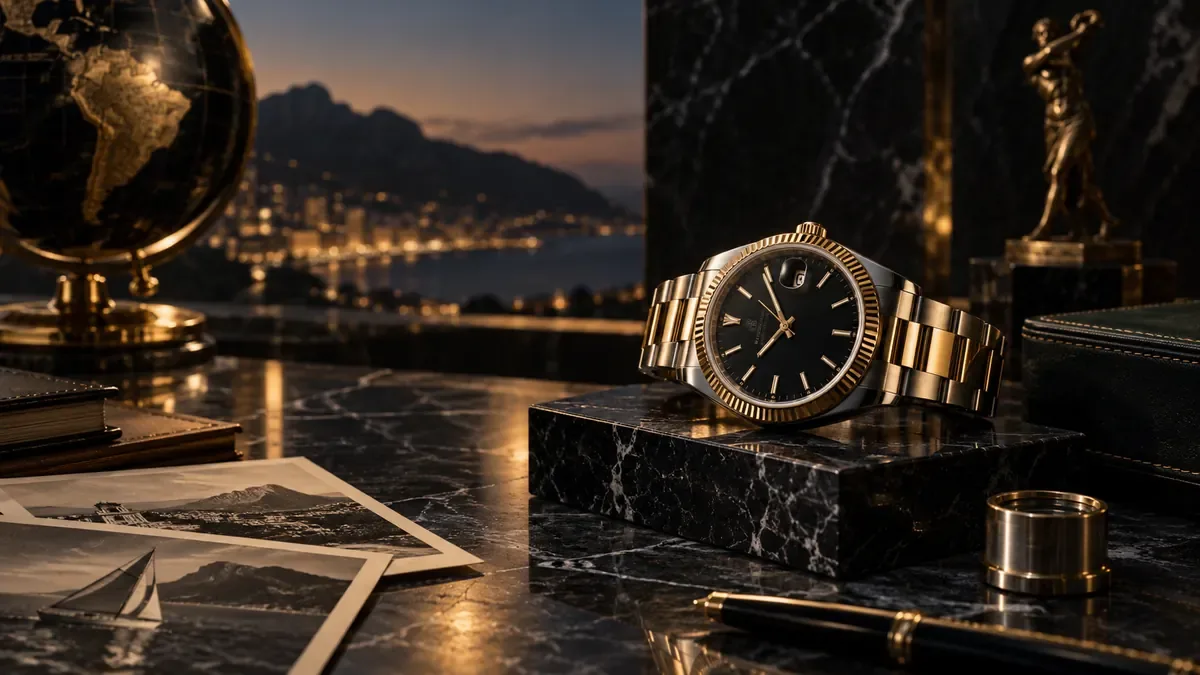

Status symbols are built from shared belief
A status symbol is not simply an expensive object. It is an object whose meaning is widely understood. The owner does not need to explain the signal every time. Rolex achieved this rare position: even people who know little about mechanical watches often recognize the name as shorthand for success, craftsmanship and arrival.
That meaning did not appear overnight. It was built through product innovation, public demonstrations, disciplined branding and repeated association with achievement. The interesting question is not “Why is Rolex expensive?” It is “How did one watch brand become culturally legible as status?”
1. Product proof came before mythology
In 1926 Rolex introduced the Oyster, a waterproof wristwatch. In 1927, swimmer Mercedes Gleitze wore an Oyster during an English Channel swim lasting more than ten hours, and the watch continued to function. Hans Wilsdorf turned the demonstration into publicity, including a prominent Daily Mail advertisement.
This mattered because the brand story was anchored in a tangible technical claim. Reliability was not only asserted; it was dramatized. Strong luxury brands often begin with proof before they accumulate mythology.
2. The brand attached itself to achievement
Rolex repeatedly associated its watches with exploration, sport and demanding environments. The logic is powerful: if the product appears where human beings test limits, the brand borrows meaning from those achievements. Over decades, this creates a symbolic bridge between ownership and accomplishment.
This is more durable than celebrity alone. The strongest association is not “famous people wear this.” It is “this object belongs in the world of people who accomplish difficult things.”
3. Recognition multiplies signaling value
A status object must be recognizable enough to communicate. Obscure luxury can carry insider prestige, but broad status requires shared literacy. Rolex occupies an unusual middle ground: it is known globally, yet individual references, configurations and vintage pieces allow enthusiasts to signal deeper knowledge.
That layered recognizability is commercially powerful. The same object can communicate basic success to a broad audience and nuanced taste to a smaller one.
4. Scarcity changes the psychology of ownership
When demand for a sought-after product exceeds easy availability, the acquisition itself becomes part of the story. Ownership can signal access, patience, knowledge or timing in addition to purchasing power. That strengthens the social meaning of the object.
It is important not to oversimplify this as a single deliberate scarcity tactic. Luxury availability is shaped by production, distribution, model-specific demand and secondary markets. What matters psychologically is the perception that the object cannot always be acquired instantly on identical terms.
5. Consistency protects prestige
Luxury brands face a temptation to chase short-term growth through constant novelty, discounting or indiscriminate expansion. Prestige requires discipline. Rolex has maintained a highly consistent visual and narrative language around precision, endurance and achievement. Continuity makes the brand feel older than trends.
For ambitious businesses, the lesson is severe: positioning compounds when each new action reinforces the same core meaning. Random growth can increase revenue and weaken the signal.
6. A Rolex is also a social shortcut
Research on status suggests that humans monitor rank and react to cues that imply competence, prestige or access. A recognizable luxury watch becomes one such cue. It allows observers to make a rapid inference — accurate or not — about success, taste or resources.
This does not mean the wearer is shallow. People buy watches for engineering, history, collecting, beauty, memory or reward. But the status layer remains part of the object’s cultural power precisely because other people can read it.
The brand lesson beneath the watch
Rolex became a status symbol because technical credibility, narrative consistency, public proof and social recognizability reinforced one another for decades. The result is not just a product with a high price. It is a symbol with accumulated meaning.
That is the real moat of iconic luxury: competitors can imitate features. They cannot quickly reproduce a century of belief.
What Rolex teaches about category leadership
Rolex did not win by trying to be meaningful to everyone in every way. The brand repeatedly reinforced a narrow group of associations: precision, reliability, endurance, achievement and recognizable prestige. Category leadership becomes powerful when buyers can predict what a brand means before seeing the advertisement.
This is difficult for growing companies because short-term opportunities encourage message drift. One campaign sells affordability, another sells exclusivity, a third sells innovation and a fourth sells nostalgia. Each may work individually while collectively weakening memory. Rolex illustrates the compounding value of a coherent symbolic system.
The difference between price and prestige
A high price can create exclusion, but exclusion alone does not create prestige. Prestige requires a reason the group agrees to admire. That reason can include craft, scarcity, history, performance, cultural association or expert recognition. When those elements are absent, expensive can look arbitrary.
This is why price increases are dangerous when used as a substitute for positioning. If the symbolic and functional story is weak, a higher price produces resistance rather than desire. Price amplifies meaning; it does not manufacture it from nothing.
A practical brand-positioning audit inspired by Rolex
- What single idea should the market associate with us?
- What proof makes that idea credible?
- Which contexts reinforce the meaning rather than dilute it?
- What behavior would cheapen the signal?
- What do insiders notice that casual buyers do not?
- Which parts of the identity should remain consistent for years rather than campaigns?
The point is not to imitate Rolex aesthetics. It is to understand compounding. A brand becomes culturally strong when product truth, proof, distribution and symbolism repeat the same meaning long enough for the market to remember it without being reminded.
Why heritage works only when the present still performs
Heritage is powerful, but it can become a museum label if the current product no longer justifies attention. Rolex’s historical narrative remains commercially useful because the brand continues to connect its identity to precision, robustness and recognizable design. The past strengthens the present only when the present is credible enough to carry it.
This is an important distinction for any premium brand. Storytelling cannot permanently compensate for a weak product. The strongest brands create a loop: product performance makes the story believable, the story makes the product meaningful, and consistency allows both to compound over time.
The practical lesson for premium brands
If you are building a premium offer, do not start by copying luxury aesthetics. Start by identifying the proof your market can trust. Then decide which associations you want to compound for years, not weeks. Protect distribution, pricing and creative choices that reinforce those associations. Prestige is not a visual filter. It is the accumulated result of product truth, selective context and disciplined repetition.
Why resale value strengthens the story without defining it
Many buyers also pay attention to the secondary market because retained value makes a luxury purchase feel more defensible. But resale value should be treated as an outcome, not the essence of the brand. Markets move, individual references behave differently and no watch should be treated as a guaranteed investment merely because past demand was strong.
What matters for the status story is that durability, recognizability and collector demand can reinforce the perception that the object has a life beyond a single season. That perception supports the idea of permanence — a quality luxury brands prize because permanence is the opposite of disposable fashion.
The danger of confusing the symbol with the achievement
A status object is most psychologically satisfying when it marks a reality that already exists: a milestone, a craft obsession, a memory or a reward. Trouble begins when the object is purchased to manufacture the identity first. Then the owner has to keep feeding the symbol because the underlying achievement never catches up.
That is why Rolex is such a useful case study for Millionaire Lesson. The watch is interesting, but the deeper subject is human signaling: the desire to make success visible, the market’s ability to convert proof into myth, and the discipline required to keep a premium symbol meaningful across generations.
Continue Reading
Why Classic Cars Become More Valuable: Scarcity, Design and Cultural Status
Age alone does not make a car valuable. Collector value emerges from scarcity, condition, originality, provenance, design significance and the changing tastes…
Read article →
Status Symbols: Why Humans Use Objects to Signal Identity, Rank and Belonging
Status symbols work because objects are social information. Their meaning depends on the audience, the group, the context, and whether recognition is…
Read article →
Luxury Brand Psychology: Why People Pay More for Status, Scarcity and Meaning
Luxury purchases can carry functional value, but their price often depends on symbolic value: status, belonging, distinction, scarcity, craftsmanship, heritage, and the…
Read article →Quiet Luxury: Why Subtle Signals Can Be More Powerful Than Obvious Logos
Quiet luxury describes premium consumption in which material quality, cut, construction, provenance, and insider recognition matter more than highly visible branding.
Read article →