The Roman Emperors Who Changed History — and the Decisions That Built an Empire
Some emperors inherited Rome. Others changed its operating system. These rulers reshaped territory, institutions, religion, administration and the meaning of imperial power.
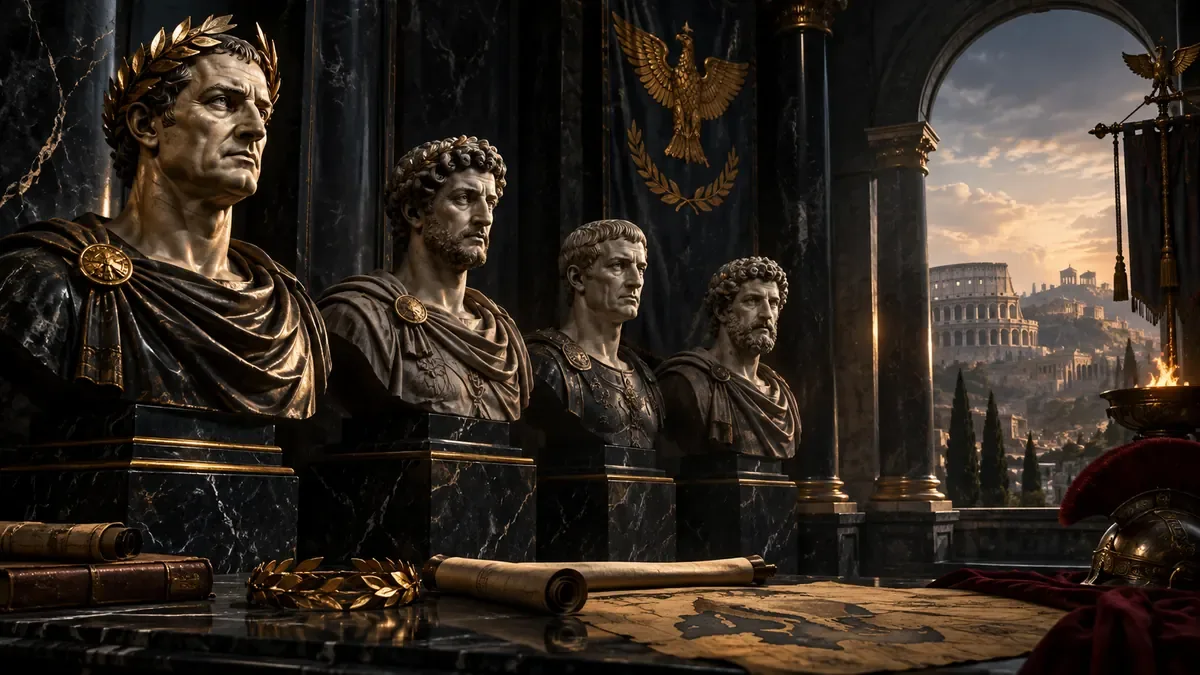

History changes when a ruler changes the system
Not every Roman emperor altered the course of civilization. Many inherited structures built by others, managed them for a time and disappeared into chronology. A smaller group made choices that changed the architecture of the empire itself: how authority was justified, how territory was managed, how succession worked, how religion interacted with the state or how a crisis was answered.
These emperors are useful to study not because they offer simple leadership formulas, but because they reveal leverage. One decision at the top of a large system can reshape institutions for generations — sometimes intentionally, sometimes not.
Augustus: turn victory into a system
Augustus solved the most difficult problem facing a revolutionary: what comes after victory. He did not merely defeat rivals. He created a durable political settlement that concentrated authority while preserving familiar republican language and offices. The achievement was organizational as much as military.
The lesson is that raw power is temporary until it becomes process, expectation and legitimacy. Great founders often make the same transition: from personal force to institutional design.
Vespasian: restore confidence after chaos
After the civil conflict of 69 CE, known as the Year of the Four Emperors, Vespasian founded the Flavian dynasty and brought a measure of stability. His reign illustrates a recurring leadership task: after crisis, the first requirement is often not visionary expansion but credibility, fiscal repair and predictable administration.
A system exhausted by uncertainty values normality more than drama. Leaders who understand the emotional state of an institution can choose the right tempo.
Trajan: expansion at the edge of capacity
Under Trajan, the Roman Empire reached its greatest territorial extent. Expansion made Rome richer in prestige and, in some cases, resources, but it also increased the burden of defense and administration. The strategic question is familiar: when does scale create more leverage, and when does it create more surface area to defend?
Expansion is rarely free. The visible upside arrives before the full integration cost.

Hadrian: know when to consolidate
Hadrian traveled extensively through the empire, strengthened frontiers and is closely associated with consolidation rather than continued maximal expansion. His reign demonstrates a form of leadership often underrated by ambitious people: strategic restraint.
There are seasons for attack and seasons for architecture. A leader who cannot tell the difference can turn momentum into overextension.
Marcus Aurelius: duty in an unfavorable environment
Marcus Aurelius inherited neither a perfect world nor an easy reign. Military conflict and epidemic disease placed pressure on the empire. His historical significance partly comes from the unusual combination of supreme political authority and a surviving private philosophical notebook.
His example reminds us that leadership quality is not measured only by how a person behaves when incentives are aligned. Pressure reveals whether principles are structural or decorative.
Diocletian: redesign the state when the old model stops scaling
By the late third century, repeated crises had exposed the limits of existing imperial arrangements. Diocletian reorganized administration and established the Tetrarchy, a system of multiple rulers intended to make succession and governance more manageable across a vast territory.
The arrangement did not permanently solve Rome’s succession problems, but the attempt itself is instructive. When a system repeatedly fails, optimization may no longer be enough. Sometimes the structure must be redesigned.
Constantine: decisions that outlive the decision-maker
Constantine’s reign changed the religious and political trajectory of the empire. His support for Christianity and the foundation of Constantinople as a major imperial center had consequences far beyond his lifetime.
This is a reminder of asymmetric decisions: some choices are not merely operational. They change the map on which future choices are made.
What these emperors have in common
- They recognized a structural problem rather than only a local symptom.
- They made choices with second-order consequences for institutions.
- They managed legitimacy as well as force.
- They changed how later rulers would understand the job itself.
The most important leaders in history are rarely those who simply performed the existing role well. They are the ones who changed the role, the system or the constraints around it. Rome offers some of the clearest examples ever recorded.
The pattern behind the history-changing reigns
The most consequential emperors tended to intervene at moments when the existing arrangement had reached a limit. Augustus answered civil war with a new political settlement. Vespasian answered regime chaos with stabilization. Hadrian answered expansion with consolidation. Diocletian answered third-century instability with administrative redesign. Constantine reoriented political geography and the state’s relationship with Christianity.
Their choices were different because the bottleneck was different. This is a crucial strategic lesson: copying a successful predecessor can be dangerous when the constraint has changed. Trajan’s expansionary logic and Hadrian’s consolidation logic are both intelligible in context; either would be foolish if applied automatically to the other’s problem.
What leaders should learn from historical turning points
Turning points reward diagnosis. Is the system suffering from insufficient ambition, or from overextension? From too little central authority, or too much dependence on one center? From lack of legitimacy, or lack of execution? History-changing decisions often look obvious only after the fact because later observers already know which constraint mattered most.
For a founder or operator, the equivalent question is: what is the limiting factor now? Capital, demand, trust, talent, distribution, process, positioning or leadership capacity? Strategy becomes sharper when the answer changes the allocation of resources.
A reading framework for Roman leadership
- Context: what problem did the ruler inherit?
- Constraint: what limited the empire’s options?
- Decision: what did the emperor change?
- Second-order effect: what new problems did the solution create?
- Durability: did the change survive the ruler?
- Legitimacy: who accepted the change and why?
Reading history this way turns chronology into a laboratory. The goal is not to imitate emperors. It is to practice seeing systems, constraints and consequences across a longer time horizon than everyday business usually allows.
Why the consequences were often larger than the intention
Imperial decisions interacted with institutions, geography, religion and military incentives in ways no ruler could fully control. A reform designed to stabilize succession could create new rivalries. A territorial gain could create a frontier burden. A religious accommodation could reshape identity across centuries. Leaders operate inside systems that answer back.
That is why historical judgment should include second-order effects. The first-order question is what a ruler wanted. The more useful strategic question is what the decision made possible, expensive or inevitable for the people who came later. Durable leadership is measured partly by the quality of the constraints it leaves behind.
Use history as a decision laboratory
When reading any emperor, resist the temptation to ask only whether he was “good” or “bad.” Ask what constraint he faced, what alternatives existed, which stakeholders mattered, what the decision solved and which new problem it created. This turns history from moral theater into strategic practice. The past cannot give you a formula, but it can expand the number of patterns you recognize before making your own irreversible choices.
The leadership paradox of scale
As Rome grew, the value of central coordination increased — and so did the impossibility of one center understanding everything. This tension sits behind many imperial reforms. Larger systems need standards, delegation, information networks and local judgment. Too little central control fragments the system; too much creates bottlenecks and blindness.
The same paradox appears in companies that move from founder-led teams to complex organizations. The leadership challenge changes from making every important decision to designing a system in which good decisions can be made without the founder being present in every room.
Continue Reading
Roman Empire Emperors: Who Ruled Rome and What Their Leadership Reveals About Power
Rome’s emperors ruled through more than force. Their success depended on armies, legitimacy, administration, succession and the ability to make personal power…
Read article →Augustus and the Roman Empire: How One Man Turned Civil War Into a System of Power
Augustus did more than win a civil war. He converted military victory into a political system durable enough to outlive him—and changed…
Read article →Hadrian and the Roman Empire: Why Consolidation Can Be More Powerful Than Expansion
Hadrian inherited an empire near its greatest territorial extent. His most important strategic choice was not to keep expanding, but to make…
Read article →What Was the Pax Romana? How Rome Created Two Centuries of Relative Stability
The Pax Romana was a period of relative stability, not universal peace. Here is how Augustus and his successors used institutions, infrastructure,…
Read article →